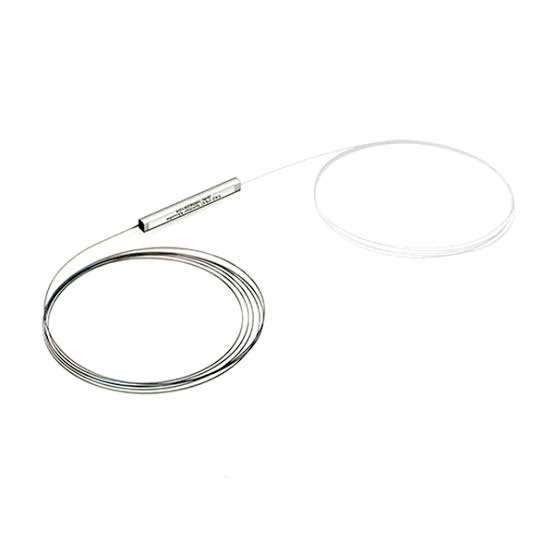
Bare Fibre PLC Splitters Price in Kenya
Bare PLC Splitter 1x16 in Kenya
KSh 500.00
1 available
Continue shoppingBare PLC Splitter 1x16 in Kenya
The Bare PLC Splitter 1x16 is a passive fibre optic component designed to divide one incoming single-mode optical signal into 16 output fibre paths. It uses Planar Lightwave Circuit technology to provide controlled and relatively uniform optical power distribution, making it suitable for FTTH, GPON, EPON, FTTx and other passive optical network architectures. Professional 1x16 PLC splitter families commonly operate across 1260–1650 nm and are designed for compact optical distribution.
The bare configuration is especially useful where fibre-distribution space is limited. Commercial 1x16 models are available with 250 µm bare single-mode fibre, no connectors and compact steel-tube packaging, allowing installers to fusion-splice the splitter directly into ODFs, FDBs, FAT boxes, joint closures and splice trays.
At Fiber Optics Kenya, the Bare PLC Splitter 1x16 is ideal for ISPs, telecommunications companies, fibre contractors, FTTH installers, property developments and network integrators requiring efficient one-to-many optical distribution. Customers can also source compatible SC/APC pigtails, FDB/FAT boxes, ODFs, fusion splice sleeves, fibre trays, FTTH drop cables, fusion splicers and fibre testing tools.
Key Product Specifications
| Specification | Details |
|---|---|
| Product Name | Bare PLC Splitter 1x16 |
| Product Type | Passive Optical PLC Splitter |
| Configuration | 1 × 16 |
| Number of Inputs | 1 |
| Number of Outputs | 16 |
| Splitting Technology | Planar Lightwave Circuit |
| Typical Split Type | Balanced / Symmetrical |
| Ideal Power Share per Output | Approx. 6.25% |
| Fibre Mode | Single Mode |
| Typical Fibre Category | OS2 |
| Common Fibre Type | G.657A1 or equivalent |
| Typical Bare Fibre Diameter | 250 µm |
| Connector Type | None on bare version |
| Typical Operating Wavelength | 1260–1650 nm |
| Theoretical Splitting Loss | Approx. 12.04 dB |
| Typical Maximum Insertion Loss | Around ≤13.5 dB |
| Typical Uniformity | Around ≤1.2 dB |
| Typical PDL | Around ≤0.3 dB |
| Typical Return Loss | ≥55 dB |
| Typical Directivity | ≥55 dB |
| Operating Temperature | Commonly around -40°C to +85°C |
| Package Style | Bare fibre / mini steel tube |
| Power Requirement | None |
| Applications | FTTH, GPON, EPON, ODF, FDB, PON |
| Professional Installation | Available |
| Delivery | Available throughout Kenya |
A published bare PLC splitter datasheet specifies ≤13.5 dB insertion loss for 1x16, ≤1.2 dB uniformity, ≤0.3 dB PDL, ≥55 dB return loss and ≥55 dB directivity, with a 1260–1650 nm operating range and G.657A1 fibre.
What Does Bare PLC Splitter 1x16 Mean?
| Term | Meaning |
|---|---|
| PLC | Planar Lightwave Circuit |
| 1x16 | One optical input divided into 16 outputs |
| Bare | Unconnectorized fibre leads |
| Splitter | Passive optical power-distribution device |
| Single Mode | Fibre optimized for long-distance transmission |
| 250 µm | Common coating size for bare splitter fibre |
| PON | Passive Optical Network |
| FTTH | Fibre to the Home |
| Balanced | Optical power distributed approximately evenly |
The splitter is completely passive, meaning it requires no electricity, software, power supply or network configuration.
How a 1x16 PLC Splitter Works
The incoming optical signal enters through one fibre and the internal PLC circuit divides its optical power across sixteen output channels.
| Stage | Function |
|---|---|
| Input Fibre | Receives incoming optical signal |
| PLC Circuit | Divides optical power |
| Outputs 1–4 | Carry split optical power |
| Outputs 5–8 | Carry split optical power |
| Outputs 9–12 | Carry split optical power |
| Outputs 13–16 | Carry split optical power |
An ideal sixteen-way split has approximately 12.04 dB theoretical splitting loss. Real-world PLC devices add some excess loss, which is why professional 1x16 splitter specifications commonly reach around 13.5 dB maximum insertion loss.
Typical 1x16 Optical Distribution
| Parameter | Value |
|---|---|
| Inputs | 1 |
| Outputs | 16 |
| Ideal Optical Power per Output | 6.25% |
| Theoretical Split Loss | ~12.04 dB |
| Typical Practical PLC Loss | ~13–14 dB |
| External Electrical Power | None |
The actual optical level at each subscriber also depends on fibre attenuation, connector losses, splice losses, adapter losses and any additional splitter stages.
PLC Splitter Technology
PLC splitters use silica-based optical waveguides to divide incoming light across multiple output channels.
| PLC Feature | Benefit |
|---|---|
| Multiple Split Ratios | Supports scalable fibre networks |
| Wide Wavelength Range | Suitable for PON systems |
| Balanced Output Channels | Consistent optical distribution |
| Low PDL | Stable optical performance |
| Compact Package | Suitable for small fibre enclosures |
| Passive Operation | No power required |
| High Reliability | Suitable for access networks |
| Single-Mode Operation | Excellent for FTTH |
Bare PLC splitter families commonly include 1x2, 1x4, 1x8, 1x16, 1x32 and 1x64 versions.
Typical Optical Performance
| Optical Parameter | Typical / Representative Value |
|---|---|
| Configuration | 1x16 |
| Operating Wavelength | 1260–1650 nm |
| Typical Fibre | G.657A1 |
| Insertion Loss | ≤13.5 dB |
| Loss Uniformity | ≤1.2 dB |
| Polarization Dependent Loss | ≤0.3 dB |
| Return Loss | ≥55 dB |
| Directivity | ≥55 dB |
| Fibre Diameter | 250 µm commonly |
| Fibre Mode | Single Mode |
These are representative specifications rather than guaranteed values for every supplier's product.
Why the 1260–1650 nm Range Matters
The broad operating range allows a PLC splitter to carry optical signals used by different PON and single-mode fibre technologies.
| Wavelength | Typical Network Use |
|---|---|
| 1310 nm | Upstream optical transmission |
| 1490 nm | Common GPON downstream |
| 1550 nm | Optical video and additional services |
| 1577 nm | Used in newer PON architectures |
| 1625 nm | Fibre monitoring and testing |
G.657A1 Single Mode Fibre
Bare PLC splitters commonly use G.657A1 bend-insensitive single-mode fibre, which is useful when many splitter outputs need to be routed within compact enclosures.
| G.657A1 Feature | Benefit |
|---|---|
| Single Mode | Long-distance optical performance |
| Bend Insensitive | Better performance around tight bends |
| FTTH Use | Excellent |
| FDB Installation | Excellent |
| ODF Routing | Excellent |
| Splice Tray Installation | Excellent |
| Compact Enclosure Use | Excellent |
Bare Fibre Construction
The bare design leaves the input and output leads without factory-installed connectors.
| Bare Fibre Feature | Benefit |
|---|---|
| No Connectors | Flexible termination |
| 250 µm Leads | Extremely compact |
| Fusion-Splice Ready | Direct installation into network |
| Minimal Space | Excellent for FDBs |
| Steel Tube Protection | Protects PLC circuit |
| Custom Termination | APC, UPC or direct splice possible |
| Colour-Coded Outputs | Easier fibre management |
Commercial 1x16 versions are available specifically as steel-tube, 250 µm bare fibre splitters without connectors.
250 µm vs 900 µm PLC Splitter
| Feature | 250 µm | 900 µm |
|---|---|---|
| Fibre Diameter | Smaller | Larger |
| Space Requirement | Lowest | Slightly Higher |
| Mechanical Protection | Lower | Better |
| Handling | More Delicate | Easier |
| Splice Tray Use | Excellent | Excellent |
| FDB Installation | Excellent | Excellent |
| Bare Splitter Use | Very Common | Common |
Bare PLC Splitter vs Mini Blockless PLC Splitter
| Feature | Bare 1x16 | Mini Blockless 1x16 |
|---|---|---|
| Overall Size | Very Small | Small |
| Typical Fibre Leads | 250 µm | 900 µm commonly |
| Mechanical Protection | Lower | Better |
| Connector Options | Usually None | Optional |
| Splice Tray Integration | Excellent | Excellent |
| FDB Installation | Excellent | Excellent |
| Handling Strength | Lower | Better |
A mini 1x16 splitter can also be supplied without connectors while using a protected steel package and larger buffered leads.
Bare PLC Splitter vs ABS Box PLC Splitter
| Feature | Bare PLC 1x16 | ABS Box 1x16 |
|---|---|---|
| Physical Size | Very Compact | Larger |
| Mechanical Protection | Lower | Higher |
| Bare Outputs | Common | Optional |
| Connectorized Options | Less Common | Very Common |
| Splice Tray Installation | Excellent | Less Compact |
| Rack / Cabinet Use | Requires Enclosure | Excellent |
| Installation Flexibility | High | Moderate |
1x4 vs 1x8 vs 1x16 PLC Splitter
| Feature | 1x4 | 1x8 | 1x16 |
|---|---|---|---|
| Outputs | 4 | 8 | 16 |
| Ideal Power per Output | 25% | 12.5% | 6.25% |
| Theoretical Split Loss | ~6.02 dB | ~9.03 dB | ~12.04 dB |
| Representative Max PLC Loss | ~7.1 dB | ~10.3 dB | ~13.5 dB |
| Subscriber Capacity | 4 | 8 | 16 |
| Optical Budget Requirement | Lower | Moderate | Higher |
| FTTH Distribution | Excellent | Excellent | Excellent |
Representative bare PLC specifications list approximately 7.1 dB for 1x4, 10.3 dB for 1x8 and 13.5 dB for 1x16.
1x16 vs 1x32 PLC Splitter
| Feature | 1x16 | 1x32 |
|---|---|---|
| Outputs | 16 | 32 |
| Ideal Power per Output | 6.25% | 3.125% |
| Theoretical Split Loss | ~12.04 dB | ~15.05 dB |
| Typical Max PLC Loss | ~13.5 dB | ~16.8 dB |
| Subscriber Capacity | 16 | 32 |
| Optical Budget Flexibility | Better | Lower |
| High-Density FTTH | Excellent | Excellent |
A 1x16 splitter offers fewer subscriber outputs but preserves approximately 3 dB more optical power than a comparable 1x32 split. Representative splitter data gives 13.5 dB versus 16.8 dB maximum insertion loss.
Balanced 1x16 PLC Splitter
A standard 1x16 PLC splitter is typically designed as a balanced splitter, giving approximately equal optical power to each output.
| Parameter | Balanced 1x16 |
|---|---|
| Inputs | 1 |
| Outputs | 16 |
| Ideal Share per Output | 6.25% |
| Output Distribution | Approximately Equal |
| FTTH Suitability | Excellent |
| GPON Suitability | Excellent |
| Subscriber Density | Medium to High |
Why Choose a 1x16 Split Ratio?
A 1x16 splitter offers a strong balance between subscriber capacity and optical power budget.
| Deployment | Benefit |
|---|---|
| Apartment Block | Serve multiple units |
| Residential Estate | Efficient subscriber branching |
| Office Building | Support multiple fibre endpoints |
| Small Campus | Flexible distribution |
| ISP FTTH Network | Improve feeder utilization |
| FDB / FAT Box | Up to 16 downstream branches |
| Commercial Building | Distribute fibre across offices |
Cascaded PLC Splitting
A 1x16 splitter can operate alone or as part of a cascaded splitter architecture.
| Splitter Combination | Potential Outputs |
|---|---|
| Single 1x16 | 16 |
| 1x2 → 1x8 | 16 |
| 1x4 → 1x4 | 16 |
| 1x2 → 1x16 | 32 |
| 1x4 → 1x16 | 64 |
Cascading splitters provides deployment flexibility but increases optical loss. Every splitter stage must therefore be included in the full network optical budget.
Optical Budget Considerations
| Loss Source | Must Be Included? |
|---|---|
| 1x16 PLC Splitter | Yes |
| Feeder Fibre | Yes |
| Distribution Fibre | Yes |
| Drop Fibre | Yes |
| Fusion Splices | Yes |
| Connector Pairs | Yes |
| Adapters | Yes |
| Additional Splitters | Yes |
| Engineering Margin | Yes |
Since a typical 1x16 PLC splitter can contribute around 13.5 dB insertion loss, optical-budget planning is essential before installation.
Key Benefits of Bare PLC Splitter 1x16
Sixteen Optical Outputs
A single incoming feeder fibre can provide 16 downstream optical paths.
Compact Installation
Bare 250 µm fibres minimize the amount of space required inside FDBs, ODFs and splice trays.
Wide Operating Wavelength
Professional PLC splitter families commonly operate from 1260–1650 nm.
Balanced Optical Distribution
PLC technology provides controlled power distribution across all sixteen outputs.
Low Polarization Dependence
Representative 1x16 models specify approximately ≤0.3 dB PDL.
Bend-Insensitive Fibre
G.657A1 options improve routing within compact fibre enclosures.
No Electricity Required
The splitter is completely passive and has no power supply or configuration requirements.
Watch Bare PLC Splitter 1x16
Watch on YouTube: https://youtu.be/5nxxutpEzHM
The Bare PLC Splitter 1x16 provides a compact and efficient way to distribute one incoming single-mode fibre signal across sixteen downstream paths. Commercial 1x16 versions are available with 250 µm bare fibres, no connectors and compact steel-tube housings, making them suitable for installation inside fibre distribution boxes, ODFs, splice trays and other restricted spaces.
A balanced 1x16 splitter theoretically provides approximately 6.25% of the incoming power to each output, corresponding to roughly 12.04 dB ideal splitting loss. In practical PLC devices, total insertion loss is typically higher; representative professional specifications list approximately 13.5 dB maximum insertion loss, along with low PDL and high return loss.
Because the bare version comes without connectors, technicians can tailor the termination method to the network design. Fiber Optics Kenya can supply Bare PLC Splitter 1x16 units alongside SC/APC pigtails, FDB/FAT boxes, ODFs, splice trays, fusion sleeves, FTTH drop cables, fusion-splicing tools and optical testing equipment, helping installers source a complete passive optical distribution solution.
Applications of Bare PLC Splitter 1x16
1. FTTH Networks
Distribute one feeder fibre to as many as sixteen subscriber or downstream branches.
2. GPON Networks
Provide passive optical distribution between an OLT and multiple ONTs.
3. EPON Networks
Split Ethernet PON optical signals without powered switches.
4. Fibre Distribution Boxes
Install the splitter inside an FDB to provide up to sixteen downstream fibres.
5. FAT Boxes
Provide compact fibre branching for subscriber connections.
6. Optical Distribution Frames
Integrate the splitter into structured fibre-management systems.
7. Fibre Joint Closures
Fusion-splice bare leads directly into outside-plant fibre networks.
8. Apartment Buildings
Serve multiple residential units from a shared feeder fibre.
9. Commercial Buildings
Provide optical distribution across offices, floors or departments.
10. ISP Access Networks
Improve feeder-fibre utilization while supporting multiple subscribers.
Typical FTTH Network Using Bare PLC Splitter 1x16
| Network Stage | Typical Component |
|---|---|
| Provider Equipment | OLT |
| Feeder Fibre | Single Mode |
| Splitter Input | 1 Fibre |
| Optical Splitter | Bare PLC Splitter 1x16 |
| Splitter Outputs | 16 Fibres |
| Distribution Enclosure | FDB / FAT |
| Subscriber Connections | FTTH Drop Cable |
| Subscriber Equipment | ONT / ONU |
Installation Considerations
| Installation Factor | Recommendation |
|---|---|
| Optical Power Budget | Calculate before deployment |
| Bare Fibre Protection | Install inside protected enclosure |
| Output Identification | Label all sixteen fibres |
| Bend Radius | Follow fibre requirements |
| Fusion Splicing | Use precision splicing equipment |
| Splice Sleeves | Protect every fusion splice |
| Fibre Management | Use suitable splice trays |
| Testing | Measure power on every output |
| Connector Cleaning | Clean downstream interfaces |
| Engineering Margin | Maintain sufficient power margin |
Recommended Accessories
| Accessory | Purpose |
|---|---|
| SC/APC Pigtails | Terminate bare outputs with APC |
| SC/UPC Pigtails | UPC termination where required |
| Fusion Splice Sleeves | Protect fibre joints |
| Fibre Splice Tray | Organize splitter leads |
| FDB / FAT Box | Houses splitter and fibres |
| Optical Distribution Frame | Structured fibre management |
| FTTH Drop Cable | Subscriber connections |
| Fibre Cleaver | Precision fibre preparation |
| Fibre Stripper | Removes optical fibre coating |
| Fusion Splicer | Joins splitter fibres |
| Optical Power Meter | Measures optical signal |
| PON Power Meter | Tests PON wavelengths |
| Visual Fault Locator | Identifies fibre paths |
| OTDR | Tests complete fibre links |
Why Buy Bare PLC Splitter 1x16 from Fiber Optics Kenya?
| Why Choose Fiber Optics Kenya? | Customer Benefit |
|---|---|
| 1x16 PLC Splitters | Efficient 16-way optical distribution |
| Bare Fibre Options | Compact installation |
| Single-Mode Solutions | Suitable for FTTH and PON |
| G.657 Fibre Options | Better bend performance |
| SC/APC Pigtails | Matching termination accessories |
| FDB & FAT Boxes | Complete fibre distribution |
| ODFs & Splice Trays | Professional fibre management |
| FTTH Drop Cables | Complete subscriber installations |
| Splicing Equipment | Professional installation tools |
| Testing Equipment | Verify fibre performance |
| Technical Guidance | Help with splitter and optical-budget selection |
| Bulk Supply | Suitable for ISPs and contractors |
| Competitive Pricing | Cost-effective fibre deployment |
| Nationwide Delivery | Supply throughout Kenya |
Frequently Asked Questions
What is a Bare PLC Splitter 1x16?
It is a passive optical splitter with one input and sixteen output fibres, normally supplied without connectors for fusion-splice installation.
What does PLC mean?
PLC means Planar Lightwave Circuit.
What does 1x16 mean?
It means the splitter has one input and sixteen outputs.
How much optical power does each output receive?
An ideal balanced 1x16 splitter distributes approximately 6.25% of the incoming optical power to each output.
What is the theoretical splitting loss?
The theoretical 1x16 splitting loss is approximately 12.04 dB.
What is the typical actual insertion loss?
Professional bare PLC splitter specifications commonly list about ≤13.5 dB for 1x16.
What fibre type is commonly used?
Bare PLC splitter families commonly use G.657A1 single-mode fibre or a customer-specified equivalent.
What is the common fibre diameter?
Bare splitter versions commonly use 250 µm fibre leads.
Does it come with connectors?
A true bare PLC splitter generally comes without connectors, allowing direct fusion splicing or custom termination.
What is the operating wavelength?
Professional PLC splitters commonly operate from 1260 nm to 1650 nm.
What is the typical PDL?
Representative 1x16 PLC splitters specify approximately ≤0.3 dB PDL.
What is the typical return loss?
Representative PLC splitter families specify ≥55 dB return loss.
What is directivity?
Directivity indicates how well the splitter prevents unwanted optical energy from travelling between output channels.
What is the typical directivity?
Representative bare PLC splitters specify ≥55 dB directivity.
Does the splitter require electricity?
No. PLC splitters operate completely passively.
Is a 1x16 splitter suitable for FTTH?
Yes. PLC splitters are widely used for FTTH and other FTTx passive optical networks.
Can it be used with GPON?
Yes. A 1x16 splitter is suitable for GPON where the total optical budget supports the split ratio.
Can it be used with EPON?
Yes. PLC splitters can be used in EPON and other passive optical access networks.
Can one 1x16 splitter serve sixteen subscribers?
Potentially yes. Each output may serve one subscriber or another downstream branch, subject to the network architecture and optical budget.
Can it be installed inside an FDB?
Yes. The compact bare-fibre construction makes it especially useful inside fibre distribution boxes.
Can it be installed inside an ODF?
Yes. It can be fusion-spliced into an ODF and organized inside appropriate splice trays.
Does it require fusion splicing?
Bare versions usually require fusion splicing because the leads are unconnectorized.
Can I terminate it with SC/APC?
Yes. The bare fibres can be fusion-spliced to SC/APC pigtails where APC termination is required.
Can the splitter be cascaded?
Yes. For example, a 1x2 splitter followed by 1x8 splitters can create sixteen downstream branches. However, all splitter losses must be added to the optical budget.
What is the difference between 1x8 and 1x16?
A 1x16 provides twice as many outputs but has approximately 3 dB more splitting loss. Representative maximum insertion losses are about 10.3 dB for 1x8 and 13.5 dB for 1x16.
What is the difference between 1x16 and 1x32?
A 1x32 doubles subscriber capacity but increases splitter loss. Representative specifications list approximately 13.5 dB for 1x16 and 16.8 dB for 1x32.
Do you supply SC/APC pigtails?
Yes. Fiber Optics Kenya can supply compatible SC/APC single-mode pigtails.
Do you supply FDB and FAT boxes?
Yes. Compatible fibre distribution and fibre access terminal boxes are available.
Do you supply ODFs and splice trays?
Yes. ODFs, fibre splice trays and other termination products can be supplied.
Do you supply fibre splicing tools?
Yes. Fibre cleavers, strippers, fusion splicers and related accessories can be supplied.
Do you provide installation and optical testing?
Yes. Professional fibre splicing, termination, installation and testing support is available.
Do you deliver outside Nairobi?
Yes. Fiber Optics Kenya supplies fibre optic products and accessories throughout Kenya.
Contact Fiber Optics Kenya
Fiber Optics Kenya
Lyric House
7th Floor Room S9
Kimathi Street
Nairobi
Phone: +254 704 991 492
Email: info@fibreopticskenya.co.ke
The Bare PLC Splitter 1x16 provides compact and reliable sixteen-way optical distribution for FTTH, GPON, EPON and other passive fibre networks.
Contact Fiber Optics Kenya for competitive pricing, PLC splitters, FDBs, ODFs, fibre termination accessories, bulk orders and nationwide delivery across Kenya.